For decades, manufacturers measured performance largely through physical and financial assets: factories, equipment, inventory, capacity, revenue, margin, and cash flow. Those measures remain critical. But over the last 40 years, another asset has become increasingly important to how effectively manufacturers deploy capital, manage operations, serve customers, and create enterprise value: digital data.
For manufacturing and supply chain leaders, the ability to connect accurate data across demand, supply, production, inventory, quality, logistics, and customers increasingly determines how effectively those physical assets perform.
Every technology revolution of the last forty years has increased not only the amount of data manufacturers create, but the speed and value of what they can do with it.
To understand where manufacturing and supply chain operations are headed, look back at their digital journey. The infographic below maps this transformation and illustrates a consistent trend: data has moved from supporting individual tasks to connecting the enterprise and, increasingly, driving operational decisions and actions.
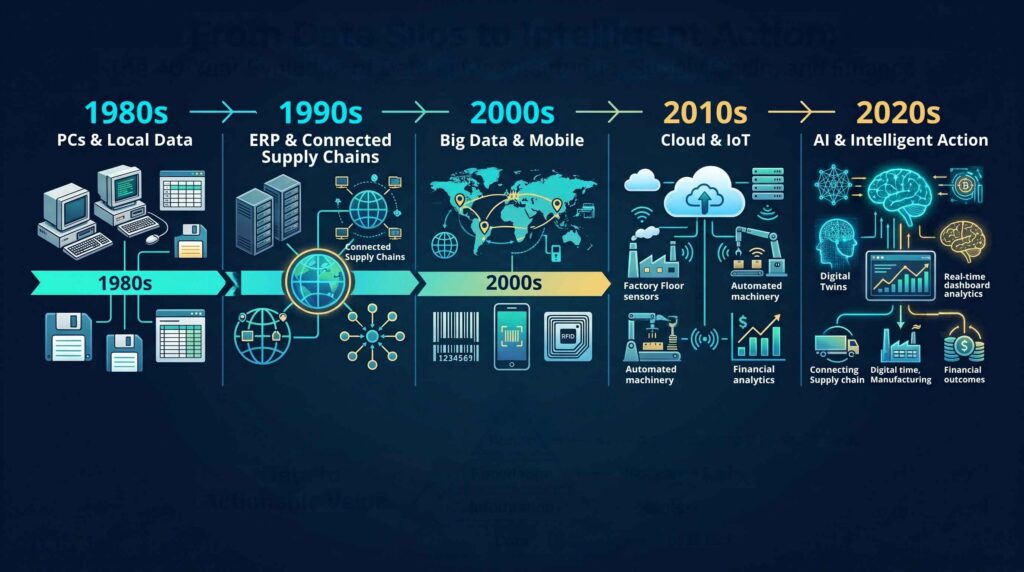
1980s: PCs, MRP & Local Data Emergence
The 1980s brought digital power closer to individual users while manufacturers continued to rely heavily on mainframes, MRP/MRP II systems, and other centralized applications for planning and transaction processing. Personal computers and spreadsheets gave planners, engineers, buyers, finance teams, and plant new personnel tools to analyze and manipulate data locally.
The result was greater local productivity, but also more fragmentation. Critical information could reside in MRP systems, departmental applications, spreadsheets, local hard drives, or early Local Area Networks (LANs). Production schedules, inventory records, bills of material, forecasts, quality information, and purchasing data were often difficult to reconcile across functions. Data supported individual departments, but enterprise-wide visibility remained limited.
1990s: ERP, Integration & Connected Supply Chains
The 1990s began breaking down many of those internal data silos. ERP systems increasingly integrated finance, manufacturing, procurement, inventory, and supply chain data—creating, at least in theory, a common transactional foundation connecting what happened operationally with its financial impact. For manufacturers, this was a major step toward connecting what had previously been separate operational views.
At the same time, commercialization of the Internet, widespread e-mail, EDI expansion, and emerging e-commerce improved connectivity with customers and suppliers. Supply chains became more digitally connected, and companies gained better visibility across orders, materials, production, and distribution. The foundation was being laid for managing the extended enterprise rather than only the individual plant or function.
But greater connectivity did not necessarily create a single version of the truth. Many manufacturers still found themselves with multiple definitions of customers, products, inventory, cost, capacity, and demand across ERP instances, plants, acquired businesses, and functional systems. The challenge increasingly became not simply collecting data, but establishing trusted enterprise data that leaders across operations, supply chain, and finance could use to make decisions from the same facts.
2000s: Globalization, Mobility & the Data Explosion
The 2000s accelerated globalization and extended digital connectivity beyond the office. Mobile devices and smartphones created new data endpoints, while manufacturers expanded global supplier networks, outsourced production, and increasingly coordinated operations across regions. Supply chain systems, warehouse management, transportation management, barcode and RFID technologies generated growing volumes of operational data.
If the 2000s were about accumulating data, the 2010s were about making that data more accessible, connected, and useful.
As supply chains became more global and outsourced, critical operating data increasingly resided outside the enterprise—with suppliers, contract manufacturers, logistics providers, and customers.
This was also the period when “Big Data” became recognizable. Businesses faced unprecedented volume, velocity, and variety of data. New analytical capabilities and roles, including the emerging Data Scientist, began helping companies find patterns across increasingly complex datasets. For manufacturing and supply chain organizations, the challenge was shifting from simply capturing transactions to connecting and making sense of data across an increasingly complex global network
2010s: Cloud, IoT & Analytics – From Data to Insight
If the 2000s were about accumulating data, the 2010s were about making that data more accessible, connected, and useful. Cloud adoption expanded access to scalable storage and computing, while hybrid and multi-cloud environments emerged. At the same time, the Internet of Things (IoT), connected equipment, sensors, telematics, and increasingly sophisticated automation began generating continuous streams of operational data from the factory floor and across the supply chain.
The opportunity was no longer simply to collect more data, but to connect it across functions and turn it into better decisions. Processes such as Sales & Operations Planning (S&OP) and Integrated Business Planning (IBP) demonstrated the value of bringing demand, supply, capacity, inventory, and financial data together into a common decision-making process. Operational performance could increasingly be connected to financial outcomes—including inventory turns, working capital, cost-to-serve, forecast accuracy, margin, asset utilization, capital allocation, and ultimately cash flow.
Analytics also moved beyond traditional retrospective reporting. Manufacturers could increasingly combine data from ERP, MES, quality, maintenance, warehouse, transportation, supplier, and customer systems to improve forecasting, OEE, inventory optimization, predictive maintenance, quality management, and end-to-end supply chain visibility.
By the end of the decade, the emphasis was no longer simply on having data. It was on transforming increasingly large volumes of operational data into timely, trusted insights that could improve both operational and financial performance—and provide the foundation for the intelligent decision-making that would define the next decade.
2020s: AI, Connected Operations & Intelligent Action
We are now entering the age of intelligent operations. The focus is shifting from understanding what happened, to predicting what is likely to happen, and increasingly to recommending or automating what should happen next. Artificial Intelligence (AI), Machine Learning (ML), Generative AI, digital twins, advanced planning, and intelligent automation are creating new ways to manage manufacturing and supply chain complexity.
For operating executives, the expectation has moved well beyond monthly reports. Leaders increasingly expect near-real-time visibility into demand, capacity, inventory, supplier risk, production performance, quality, logistics, and customer service. At the same time, greater connectivity increases cybersecurity and operational resilience risks, making data governance, security, and recovery board-level and operational priorities.
The Future Belongs to Manufacturers with Actionable Data
The journey from the 1980s to the 2020s is more than a technology timeline. It is the story of manufacturing and supply chain data moving from isolated departmental records to connected information that can support faster, better operational action.
Manufacturing has understood the importance of data accuracy for decades, yet the problem remains surprisingly persistent. GIGO – Garbage In / Garbage Out – still applies. In the AI era, perhaps the greater risk is Garbage In / Gospel Out: inaccurate data can be processed, analyzed, and presented with enough speed and confidence that people assume the answer must be correct. That single piece of data incorrectly entered on the manufacturing floor, in procurement, or in the distribution center can cascade downstream – distorting inventory, production schedules, purchasing decisions, customer commitments, product costs, margins, forecasts, and ultimately financial results.
In the AI era, perhaps the greater risk is Garbage In / Gospel Out: inaccurate data can be processed, analyzed, and presented with enough speed and confidence that people assume the answer must be correct.
Data alone is only facts and figures – part numbers, quantities, timestamps, transactions, sensor readings, orders, forecasts, routings, and inventory balances – without sufficient context. It must be accurate, but accuracy alone does not make it useful.
Information is data that has been organized, structured, and placed in context. A list of inventory balances is data; understanding which inventory is available, constrained, obsolete, committed, or at risk turns those records into information that an operating leader can use.
Knowledge adds relationships and the “why.” Why did service levels decline? Why is a production line missing schedule? Why is inventory increasing while customer fill rates deteriorate? Why is supplier performance changing? Knowledge connects information across functions so leaders can understand causes, tradeoffs, and business impact.
But knowledge still needs to become actionable. In manufacturing and supply chain environments, value is created when insight changes a decision: adjusting a production schedule, changing a sourcing strategy, reallocating inventory, intervening with a supplier, preventing a quality escape, or protecting a customer commitment. AI and connectivity are dramatically increasing the speed and scale at which those decisions can be supported.
Where AI Fits In
AI doesn’t replace the journey from data to action – it accelerates every step and raises the stakes at each one.
At the data layer, AI can increasingly assist with work that historically required substantial manual effort: cleaning, validating, classifying, reconciling, and flagging anomalies. It can identify an unusual inventory transaction, an inconsistent supplier record, or a mis-keyed production entry before the error cascades downstream. But it can also learn from bad data and embed those errors into forecasts and recommendations. Garbage in, at machine speed, is no longer just a bad report – it can become a bad decision at scale.
At the information layer, AI can accelerate the work of structuring and contextualizing information – helping map disparate datasets, standardize formats, reconcile records, and surface relationships across ERP, MES, WMS, TMS, quality, maintenance, supplier, and customer systems. For manufacturers with multiple plants, acquisitions, legacy platforms, or fragmented master data, this can be particularly valuable.
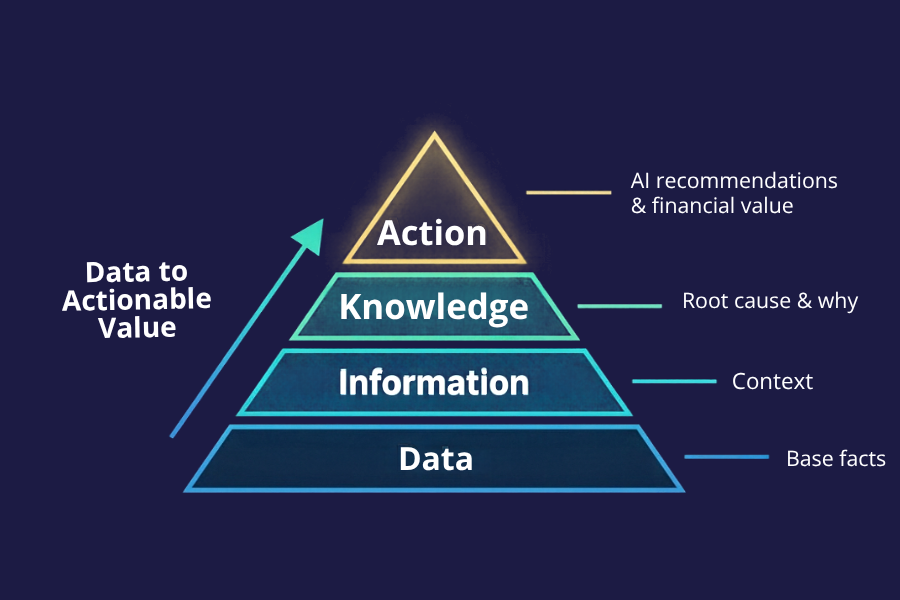
At the knowledge layer, AI can help uncover the “why” buried in operational information. Pattern recognition, predictive modeling, and root-cause analysis can identify emerging supplier risk, predict equipment failure, detect quality patterns, expose demand changes, or identify the combination of constraints most likely to disrupt a production schedule.
At the actionable layer, AI can recommend responses and help leaders evaluate tradeoffs: expedite material or change the production sequence; build inventory or preserve cash; use an alternate supplier or accept a longer lead time; prioritize one customer order over another. This is also where governance matters most. AI can advise, simulate and accelerate decisions, but executives remain accountable for decisions involving customers, employees, safety, capital, risk, and reputation.
The net effect is that AI can compress the traditional data-to-decision lifecycle into a continuous operating loop. AI can identify an emerging supplier constraint, predict its impact on production, determine which customer orders are at risk, estimate the resulting revenue and margin exposure, and recommend alternative sourcing, inventory allocation, or production scenarios. Manufacturers with strong data foundations can use AI to multiply operational advantage. Those without them risk multiplying errors – faster, wider, and with less time for human intervention.
The Executive Imperative
Data quality can no longer be viewed as an IT issue. The CIO may provide platforms and governance, but the data itself is created, consumed, and acted upon across the business.
For the manufacturing executive, poor data affects throughput, quality, capacity, and asset utilization. For the supply chain executive, it affects demand planning, inventory, sourcing, logistics, and customer service. For the CFO, it affects working capital, forecasting, margins, cash flow, and confidence in the numbers.
And increasingly, AI connects all three.
The same inaccurate inventory record that causes a planner to make the wrong replenishment decision can cause operations to change a production schedule, procurement to expedite material, finance to misstate working-capital requirements, and an AI model to recommend the wrong course of action.
There is no longer operational data, supply-chain data, financial data, and AI data. There is actionable enterprise data—and its quality increasingly determines the quality and speed of the decisions the enterprise can make.
Dr. E. Jeffrey Hutchinson is an Operating Partner with CXO Partners, focusing on AI & Technology and Supply Chain. He is a former Global CIO and senior technology and transformation executive with leadership experience across manufacturing, aerospace, consumer products, and supply chain-intensive businesses. Having served in executive roles with companies including Bombardier, Honeywell, Maple Leaf Foods, and Danone/Dannon, Accenture, NTT Data and SAP, he brings an joint operator’s and consultant’s perspective to the intersection of technology, data, AI, manufacturing, supply chain, and business performance.
Read more about Dr. Hutchinson